Rug Care in Miami: Humidity, Salt Air, and Sun
A climate guide to rug care in Miami: the humidity levels that invite mold, what salt air and sun do to fibers and dyes, how to run the AC when you are away, and a seasonal calendar.
By Bakers Rug Service · Hand-washed rug care in Miami since 1940
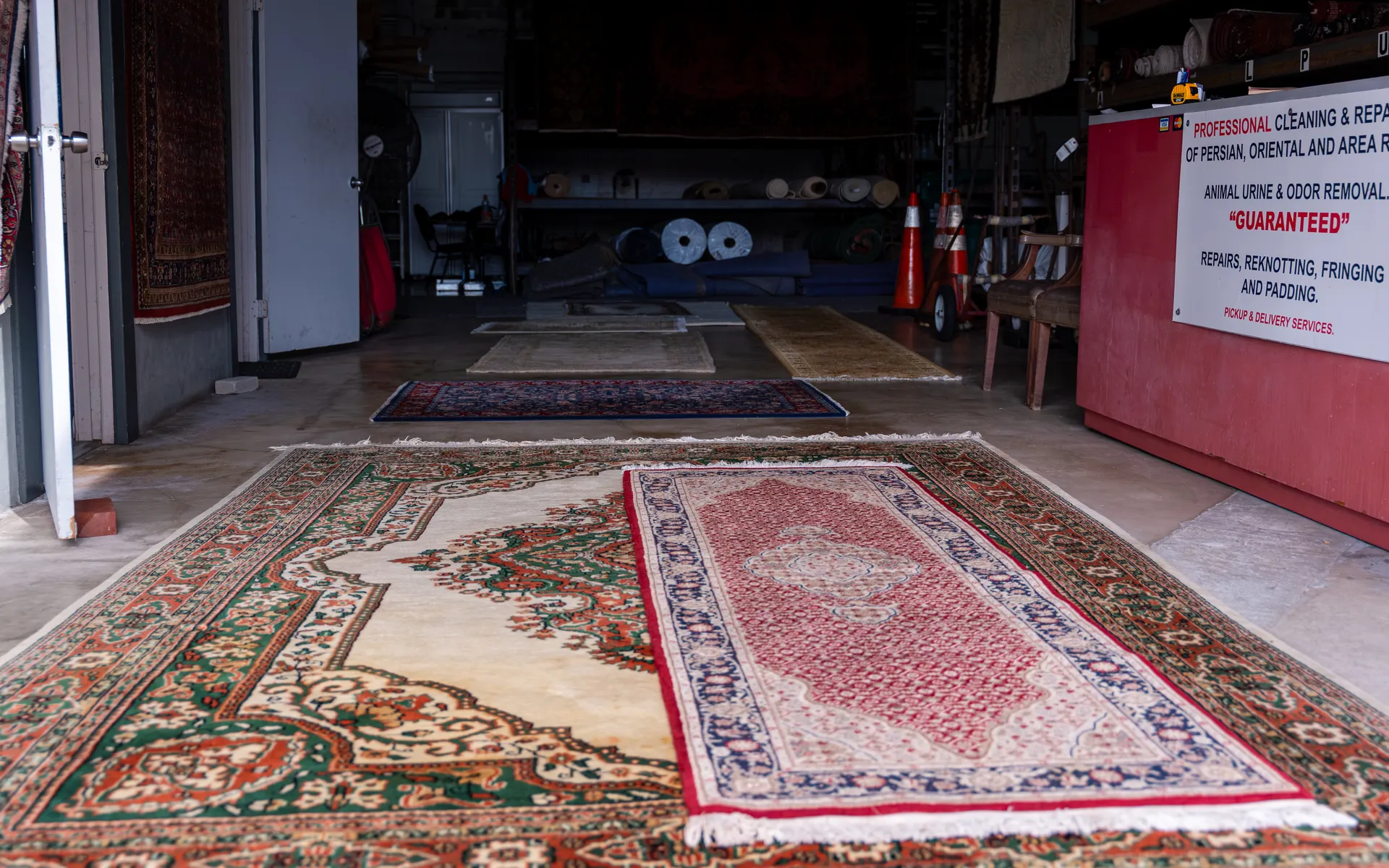
Rug care in Miami is mostly climate management. A wool or silk rug here lives with humid summers, air conditioning that cycles all day, salt on the sea breeze, strong sun and beach sand. Each works on fibers and dyes in its own way, and each has a simple countermeasure. This guide covers all five, plus hurricane season and a seasonal calendar.
Why Is Rug Care in Miami Different?
Rug care in Miami is different because the air stays humid for about five months a year, which raises the stakes for every spill, leak and AC setting.
The National Weather Service office in Miami describes Southeast Florida as having two main seasons instead of four. Summer brings warm, humid air with frequent showers and thunderstorms; winter brings cooler temperatures and lower humidity.
Two terms help:
- Relative humidity (RH) is how much water vapor the air holds compared with the most it could hold at that temperature, given as a percent.
- Dew point is the temperature at which that vapor condenses into water. The higher the dew point, the more moisture is in the air.
According to the NWS, summer dew points in South Florida stay in the lower to middle 70s. In its study of Miami records, the median summer season ran from about May 21 to October 17. During that stretch, open windows, short AC cycles and lingering spills all matter more for a rug.
How Does Miami Humidity Affect Rugs?
Damp air feeds mold and can make dyes bleed, and the humidity levels where those risks begin are well documented.
In Miami humidity, rugs absorb moisture from the air. Icon notes that textiles swell when the air is damp and shrink when it is dry, so the humidity reading in the room tells you more than the thermostat does.
| Reading or time window | What it means for rugs | Guidance from |
|---|---|---|
| Relative humidity below 60 percent, ideally 30 to 50 | Target range for preventing mold in a home | EPA |
| Relative humidity above 65 percent | Encourages mold growth, which can cause irreversible staining | Icon, the UK Institute of Conservation |
| 24 to 48 hours | How quickly wet materials should be dried to prevent mold | EPA |
What high humidity does in practice:
- Mold and mildew. The EPA notes that porous materials such as carpet may have to be thrown away once they become moldy, which is why the drying window matters.
- Dye bleeding. The Canadian Conservation Institute warns that high humidity damages fibers and may cause colors to bleed.
- Insects. Icon notes that wool carpets are particularly susceptible to moths and carpet beetles, and that dust embedded in the pile attracts insects. Our guide to preventing moths and carpet beetles covers the warning signs.
A rug that smells damp or sour after a humid week is the first alarm, and our guide on how to get a musty smell out of a rug walks through finding the source.
How to Protect Rugs From Humidity When the AC Cycles
To protect rugs from humidity, run the air conditioning to dry the air, not only to cool it, and judge the room by a humidity reading rather than the thermostat.
The EPA's moisture-control steps include using air conditioners or dehumidifiers when needed and keeping AC drip pans clean and drain lines flowing. A hygrometer, an inexpensive humidity meter, tells you whether that is working.
At home, day to day:
- Put a hygrometer near the rug you value most and check it morning and evening for a week.
- If readings sit above 60 percent, have an HVAC technician check the system and its drain line, or add a dehumidifier.
- In summer, lift a corner of each rug once a month and check the back and the floor beneath for dampness, spots or odor.
When you are away, a high thermostat setting alone is not enough. The Florida Solar Energy Center at the University of Central Florida tested humidity control in seven vacant Florida homes. Its target was indoor relative humidity at 65 percent or lower most of the time. With the thermostat at 83 or 85 degrees Fahrenheit, the AC did not run on cool, cloudy days, exactly when moisture removal was needed most.
Running the AC for two hours a day in the early morning, or using a dehumidifier on a timer or humidistat, gave effective control in that study. Ask your HVAC contractor which setup suits your home. If you own a condo in Brickell or another high-rise neighborhood, our guide to rug care for Miami condos and high-rises covers building-specific issues.
Does Salt Air Damage Rugs?
It can add to moisture problems: sea salt attracts water, so residue that settles on a rug or is tracked into it pulls moisture from humid air and holds it.
A 2023 study in Atmospheric Chemistry and Physics examined sea-salt particles collected at a coastal site. They began taking up water at about 64 percent relative humidity and dissolved fully between roughly 65 and 74 percent. Once dissolved, they did not dry back into crystals until humidity fell to about 50 percent or lower.
Those levels are easy to reach indoors with the windows open on a muggy day. In practice:
- Keep windows and sliding doors closed on humid, breezy days if you live near the water, and let the AC or a dehumidifier do the work.
- Shake out beach towels and bags outside, and rinse sandy feet and paws.
- If you see white residue near a door or a patch of pile that feels stiff, have the rug washed rather than scrubbing it yourself.
This matters most for homes on the water, from Miami Beach to Key Biscayne.
How Do You Keep the Miami Sun From Fading Rugs?
The dependable defense against sun fading is prevention: limit direct light on the rug and spread whatever exposure it gets evenly.
Icon notes that light causes dyes to fade and advises against placing a rug where sunlight shines directly on it. The Canadian Conservation Institute adds that sunlight and artificial light both do damage and that light dries out fibers. Heat also makes wool lose its natural oils, which weakens the threads.
Simple habits help:
- Close sheers or blinds during the hours when sun lands on the rug.
- Turn the rug around every year or two, as Icon suggests, so wear and any fading stay even.
- Keep silk and antique rugs out of rooms with floor-to-ceiling glass when you can.
How Do Sand and Grit Wear Down a Rug?
Sand wears a rug from the inside: the Canadian Conservation Institute says dirt and dust work into a carpet and act like sandpaper, grinding away at the base of the rug.
In a beach city, fine sand rides in on shoes, towels, strollers and paws, and settles deep in the pile where you cannot see it.
The CCI recommends:
- A standard suction head, not a power head, at a low suction setting
- Slow passes in the direction of the pile
- Vacuuming the back of the rug and the floor beneath it from time to time
Doormats inside and out, and a shoes-off habit in beach season, cut the load at the source. For a step-by-step method, see how to remove sand from a rug.
A Seasonal Rug Care Calendar for South Florida
Plan rug care around Miami's two seasons and hurricane season: prevention through the humid months, inspection and cleaning in the drier ones.
| Period | What the weather is doing | What to do for your rugs |
|---|---|---|
| December to February | Cooler, drier winter season | Inspect fronts and backs; schedule cleaning or repairs before summer |
| March to mid-May | Dry season continues; days lengthen | Turn rugs if due; note where the sun now falls and adjust blinds |
| Late May to June | Humid summer begins (median start about May 21); hurricane season opens June 1 | Set out a hygrometer; have AC drain lines and drip pans checked; make a storm plan |
| July to early August | Dew points in the lower to middle 70s | Keep RH below 60 percent; lift corners monthly; vacuum entry rugs more often |
| Mid-August to mid-October | Most hurricane activity, with the peak around September 10 | Be ready to roll and raise rugs if flooding is forecast; dry any wet rug within 24 to 48 hours |
| Mid-October to November | Humid season ends (median about October 17); hurricane season closes November 30 | Check for musty odor, spots or insect damage from summer; clean what needs it |
Hurricane Season in Brief
If flooding is forecast, roll rugs rather than folding them, because folds can crease and break threads, and lift them off the floor. If a rug does get wet, the 24-to-48-hour drying window starts right away; our guide on how to dry a wet rug explains what to do first. A rug drenched by floodwater is a job for a professional, not a fan. For a full storm checklist, read hurricane season and your rugs.
When Should You Call a Professional?
Call a professional when the problem has moved inside the rug: a smell that returns, mold, running colors, insect damage or a drenching that lasted more than a day or two.
- A musty odor that comes back even after the room's humidity is under control
- Dark spots or fuzz on the back of the rug, or a pad that has discolored
- Colors bleeding into each other or onto the fringe
- Bare patches, loose tufts or silky webbing that point to moths or carpet beetles
- Any silk, antique or heirloom rug showing one of these problems
At Bakers Rug Service, rugs are washed by hand, one at a time, never by machine.
Each starts with an inspection for dye stability, stains and structural damage, then deep dusting to remove embedded dry soil. Next come a hand wash with gentle pH-neutral solutions and repair and detail when requested. Last is controlled air drying in a climate-controlled environment to prevent mold and shrinkage. The full process is on our rug cleaning service page.
Pickup and delivery are complimentary across Miami-Dade, Broward and Palm Beach counties, and our shop is at 8723 SW 132 St in Kendall. Not sure whether your rug needs a wash or just a better routine? Tell us what you are seeing and we will help you decide, with a free estimate.
Frequently Asked Questions
Is it safe to dry a rug in the Miami sun?
Shade and moving air are gentler than a long afternoon in full sun. Strong sun fades dyes, and heat draws natural oils out of wool. Dry rugs flat or well supported in a shaded, breezy spot, turn them so both sides dry, and bring them in before evening, when the air turns damp again.
Should a rug sit directly on a tile or stone floor in a humid climate?
Icon, the UK Institute of Conservation, advises against placing rugs directly onto a stone floor, and against hanging them against the inside of an exterior wall, to avoid dampness. Over tile or stone, use a pad suited to both the floor and the rug, and lift a corner now and then in summer to check that no moisture is collecting underneath.
What should I do with my rugs before leaving Miami for the summer?
Vacuum each rug front and back and make sure it is completely dry before you go. Leave rugs flat in rooms where humidity control keeps running. During a long absence, ask someone to check a hygrometer reading and the AC drain line now and then. If a rug already smells musty or shows stains, have it cleaned before you leave rather than after.
Where should I put a hygrometer to monitor rug conditions?
Place it in the room with the rug you care about most, at about furniture height and away from AC vents, windows, kitchens and bathrooms, which can skew the reading. Check it at different times of day for a week to learn your pattern. Readings that climb every time the AC cycles off suggest the system needs attention or help from a dehumidifier.
Not Sure Your Rug Can Be Handled at Home?
Tell us about the rug and what you are noticing. We will let you know whether better home care is enough or a hand wash makes sense, with a free estimate and complimentary pickup.
Sources
- A Brief Guide to Mold, Moisture and Your Home (U.S. EPA)
- Basic Care: Carpets and Rugs (Canadian Conservation Institute)
- Carpets and Rugs: Caring for Your Treasures (Icon, The Institute of Conservation)
- Duration of Summer Season in South Florida (National Weather Service Miami)
- Assessment of the Effectiveness and Energy Efficiency of Humidity Control Approaches in Vacant Florida Homes (Florida Solar Energy Center, UCF)
- Hygroscopic Behavior of Ambient Aerosol Particles at a Coastal Site (Atmospheric Chemistry and Physics, 2023)