Moth Damage in Rugs: How to Spot It, Stop It, and Prevent It
Bald patches, silk webbing and tiny cases mean larvae are feeding. Learn to tell clothes moths from carpet beetles, clear an infestation safely and keep wool rugs protected.
By Bakers Rug Service · Hand-washed rug care in Miami since 1940
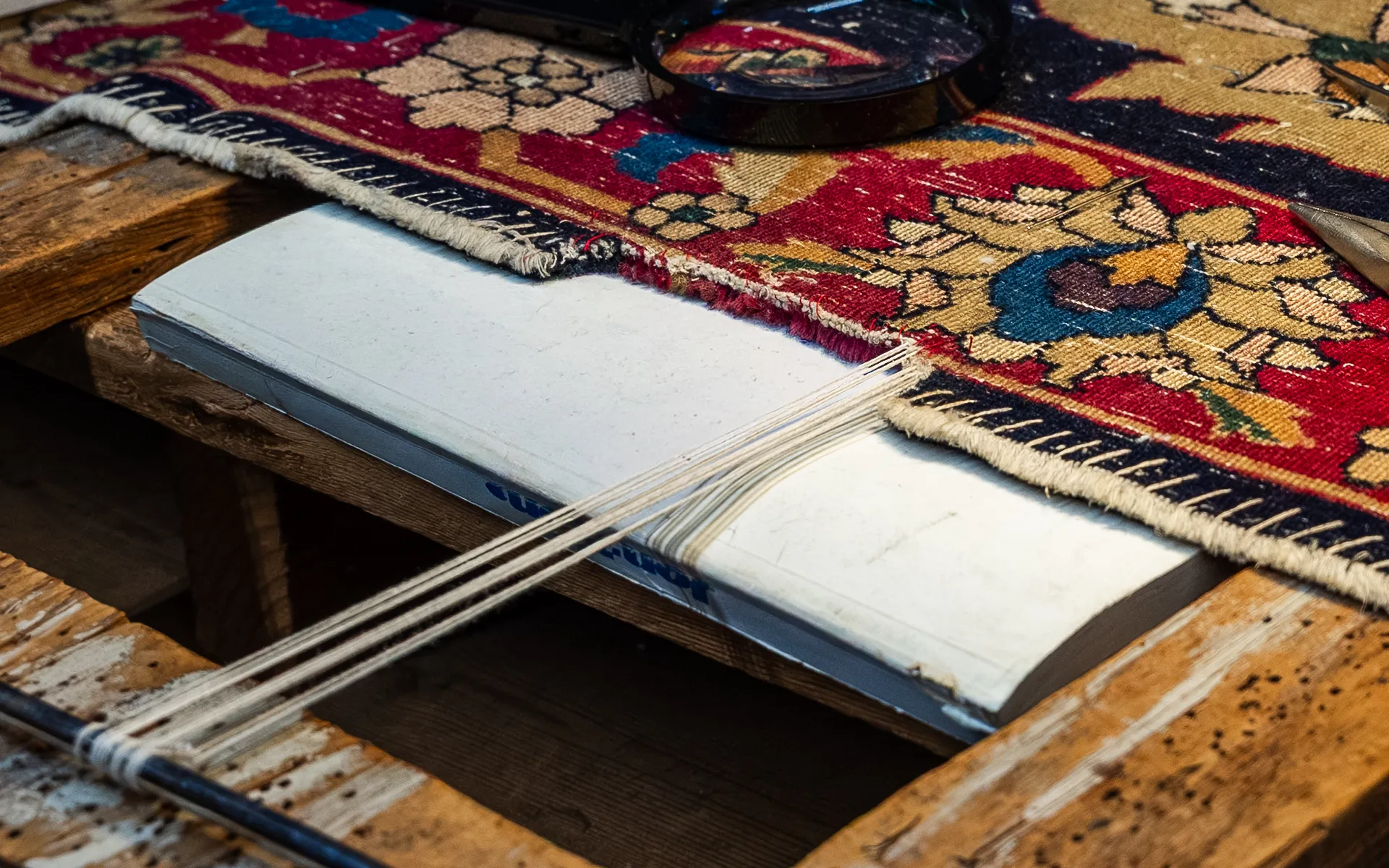
Moth damage in rugs rarely announces itself. Adult clothes moths shun light, and their larvae feed out of sight under a sofa or on the back of the rug, sometimes for months. Here is how to read the signs, name the culprit, clear it safely, and keep it from coming back.
What Does Moth Damage in Rugs Look Like?
Moth damage in rugs looks like irregular threadbare or bald patches where larvae have grazed the pile short or cut it at the base, often with silk webbing or small cases nearby. Adult moths do not feed. The larvae do all the damage.
Check for these signs:
- Threadbare or bald patches. Irregular areas where the pile, the rug's yarn surface, is thin or worn down to the foundation, the warp and weft threads it is knotted onto.
- Grazed furrows. Shallow channels where larvae have fed across the surface.
- Silk webbing or tunnels. Webbing clothes moth larvae spin silken tubes and mats that often hold bits of fiber and droppings.
- Cases. Casemaking clothes moth larvae carry an open-ended silk case, about 3/8 inch long when fully grown, often flecked with fibers from what they eat.
- Frass. Insect droppings: tiny pellets, about the size of a grain of salt for carpet beetles.
- Shed skins. Brown, bristly, shell-like skins left by molting carpet beetle larvae.
Look first where nothing disturbs the rug. University of Kentucky entomologists note that rug edges, undersides and sections beneath furniture are more likely to be attacked than open areas. Fold back each corner, check the back with a flashlight, and inspect the pile under any sofa, bed or chest.
Moths or Carpet Beetles? How to Tell Them Apart
Silk webbing or cases point to clothes moths, while brown, bristly shed skins and no webbing point to carpet beetles. The cleanup is largely the same, but knowing the pest helps you pick traps and find where the problem started.
| Clue | Clothes moths | Carpet beetles |
|---|---|---|
| Larvae | Creamy white with a dark head, up to 1/2 inch | Tan to brown, 1/8 to 1/4 inch, densely bristly |
| Adults | Buff or golden; hide from light; do not feed | Tiny oval beetles, often mottled black, white, brown, yellow or orange; feed on pollen outdoors |
| Telltale debris | Silk webbing, tunnels or cases | Shed skins and salt-grain droppings, no webbing |
| Damage pattern | Scattered holes and grazed spots | Often one larger damaged area |
Finding carpet beetles in a rug often starts with the adults. UC IPM, the University of California's integrated pest management program, notes that they are attracted to sunlight, gather on windowsills, drapes and panes, and often ride indoors on cut flowers. A few on a windowsill may signal an infestation inside.
What Is the Life Cycle of Clothes Moths and Carpet Beetles?
Both pests go from egg to larva to pupa, a resting stage, to adult, and only the larvae feed on rug fibers, sometimes for well over a year.
A female clothes moth lays an average of 40 to 50 eggs, according to UC IPM. Penn State Extension notes that they hatch in 4 to 10 days in summer but may take three weeks or more in winter. It puts development from egg to adult at one to three months, stretching to three years or more in some conditions, depending on temperature and humidity.
Carpet beetle larvae can feed for a long time, too: UC IPM lists a larval stage of 70 to 94 days for the furniture carpet beetle and 220 to 630 days for the varied carpet beetle. That long, hidden feeding is why damage can seem to appear overnight.
Warmth keeps the cycle moving. UC IPM notes that heated buildings let clothes moths keep developing through winter, and South Florida homes are warm in every season. Inspect your rugs year-round.
Why Do Moths Target Wool Rugs and the Spots Under Furniture?
Larvae of both pests feed on animal fibers and settle where it is dark and undisturbed, which makes the wool under a sofa an easy target.
They eat wool, silk, fur, feathers, felt and leather, so wool and silk rugs are on the menu while most synthetic rugs are not. Soiling raises the risk: UC IPM notes that fabrics with food, perspiration or urine stains are more subject to damage.
Location matters as much as fiber. Larvae prefer dark, secluded places, and foot traffic and vacuuming disturb them, so rugs that get normal traffic or are routinely vacuumed are seldom infested. The riskiest places are under beds, sofas and heavy cabinets, and inside rugs rolled up in a closet.
Check the pad, too. A felt pad made with wool or animal hair feeds the same larvae, and UC IPM advises treating it along with the rug unless the manufacturer already has. Replacing an old felt pad? Bakers Rug Service offers custom-cut non-slip rug pads, with moth proofing available.
How to Get Rid of Moths in a Rug
To get rid of moths in a rug, remove larvae and eggs physically first, then clean, freeze or professionally treat the rug according to its size and value.
- Vacuum both sides. Vacuum the face, the back and the floor where the rug lay, plus nearby baseboards, vents and the floor under furniture. Vacuuming removes larvae along with the hair and lint that sustain them. Empty the canister or discard the bag promptly.
- Brush small, sturdy rugs outdoors. Penn State Extension notes that throw rugs can be beaten and brushed on an outdoor line to remove most eggs and larvae. Keep sun exposure brief, because strong sun fades rug dyes.
- Freeze what fits. Seal a small rug in plastic and hold it at 0°F or colder for at least one week, or 72 hours at minus 20°F. Let it warm to room temperature for about 24 hours before unwrapping to avoid condensation, then vacuum again. Ask a professional before freezing an antique or silk rug.
- Send large or valuable rugs to a professional. A room-size rug will not fit a freezer, and the hot washing or dryer heat suggested for washable clothing is not safe for wool or silk. For expensive Oriental rugs, UC IPM points to experienced professionals rather than risky sprays.
- Treat the source, too. Inspect closets, wool clothing, blankets and upholstered furniture, and clear lint and pet hair from vents and baseboards. Persistent infestations in the home may need a professional pest control firm.
Do Mothballs, Cedar and Moth Traps Work?
Some do a narrow job and others offer false comfort: traps detect moths, mothballs work only sealed in an airtight container, and cedar is unreliable.
| Remedy | Verdict | Why |
|---|---|---|
| Pheromone traps | Monitoring, not a cure | They catch male clothes moths only; UC IPM says traps alone are not enough |
| Mothballs, flakes, crystals | Only in sealed containers | In the open, the vapor only somewhat repels adults while larvae keep feeding |
| Cedar chests and closets | Unreliable | Cedar oil can kill small larvae, not large ones, and fades after several years |
| Herbal oils and sachets | Unproven | Their effectiveness is poorly understood |
| Insecticide sprays | Last resort | Use only products labeled for the pest and surface, and test in an inconspicuous spot; oil-based sprays can stain silk |
Mothballs are pesticides. The National Pesticide Information Center (NPIC) explains that the label specifies exactly where and how they can legally be used, and that the vapors build up enough to kill moths only inside airtight containers. In an open closet or under furniture, the vapors escape into the room, and NPIC warns that misuse can harm people and pets, so keep mothballs away from children and pets.
Traps still earn a place. A pheromone trap is a sticky trap baited with the scent that draws male moths, so one in a closet can reveal clothes moth activity before damage shows. Because the lure is specific, UC IPM notes, a clothes moth trap will not catch other moths, and a pantry moth trap will not catch clothes moths.
A Simple Rug Moth Prevention Routine
Rug moth prevention comes down to a few steady habits: disturb the hiding spots, keep fibers clean and dry, keep beetles out, and store rugs clean.
- Vacuum regularly, edges included. For technique by rug type, see how to vacuum an area rug.
- Reach under the furniture. Use a slim attachment beneath sofas, beds and cabinets, the spots a quick pass misses.
- Fold back the rug now and then. Vacuum the back and the floor beneath it.
- Move furniture and rotate the rug. Changing which areas stay dark and undisturbed takes away hiding places and evens out wear.
- Clean up spills and pet accidents promptly. Residue left in the pile attracts larvae.
- Keep humidity down. UC IPM notes that low indoor humidity is unfavorable for clothes moth development, so keep air conditioning or a dehumidifier running in Miami's humid months.
- Screen windows and check cut flowers. Both are common ways adult carpet beetles get in.
- Clean before storing. Eggs and soil packed away with a rug have months to do damage. Make sure it is completely dry, then follow our guide to storing a rug.
When to Call a Professional
Call a professional when the rug is valuable or fragile, when damage has reached the foundation, or when larvae keep returning after home treatment.
- Live larvae, webbing or cases on an antique, heirloom, silk or hand-knotted rug
- Holes, exposed foundation threads, or eaten fringe and edges
- A rug too large to clean, freeze or handle safely at home
- New damage after you have vacuumed and cleaned
At Bakers Rug Service, every rug is washed by hand, individually. Each rug starts with an expert inspection for dye stability, stains and structural damage, then deep dusting to remove embedded dry soil. A hand wash with gentle pH-neutral solutions follows, then repair when requested and controlled air drying in a climate-controlled environment.
Moth damage repair is part of our rug repair and restoration services, along with hole reweaving and fringe repair. Our rug repair and restoration guide goes deeper into repairs, and our antique rug care and appraisal guide covers older pieces.
Estimates are free, and pickup and delivery are complimentary across Miami-Dade, Broward and Palm Beach counties, including Doral and Hialeah. Call (305) 232-3368 or tell us about your rug, and we will help you decide whether it needs a professional or simply a better routine at home.
Frequently Asked Questions
Can moths damage synthetic or cotton rugs?
Seldom on their own. University of Kentucky entomologists note that cotton and synthetic fibers are rarely attacked unless they are blended with wool or heavily soiled with food or body oils. Check the fiber label before you relax, though: a blend can still feed larvae, and a synthetic rug lying on a felt pad made with animal hair can host them underneath.
Should I throw away a rug that has moths?
Usually not. A well-made wool rug can be cleaned to clear the insects, and grazed patches or holes can be rewoven by a repair specialist, so weigh the rug's value, financial or sentimental, against the extent of the damage. If you do discard an inexpensive, heavily infested rug, University of Kentucky entomologists advise bagging it first so larvae and eggs stay contained on the way out.
Can moths come back after a rug is cleaned?
Yes. Cleaning and freezing remove or kill the insects present at the time, but neither leaves lasting protection. A clean rug can be reinfested by moths breeding elsewhere in the house or by carpet beetles flying in from outdoors, so find and treat the original source. Then recheck the back and edges of the rug periodically, especially anywhere furniture sits.
How can I tell clothes moths from pantry moths?
Size and flight are the quickest clues. UC IPM describes clothes moths as about 1/4 inch long at rest, roughly half the length of common food moths, and notes that they flutter rather than fly directly. Small moths in the kitchen, near flour or cereal, are more likely grain moths, which University of Kentucky entomologists say are often mistaken for clothes moths.
Not Sure Your Rug Can Be Handled at Home?
Tell us what you are seeing, or call (305) 232-3368. We will help you decide whether home care is enough or the rug needs cleaning or repair. Estimates are free.
Sources
- Clothes Moths: Pest Notes, Publication 7435 (UC Statewide IPM Program)
- Carpet Beetles: Pest Notes, Publication 7436 (UC Statewide IPM Program)
- ENTFACT-609: Clothes Moths (University of Kentucky Entomology)
- ENTFACT-601: Carpet Beetles (University of Kentucky Entomology)
- Clothes Moth (Penn State Extension)
- Regulation, Proper Uses, and Alternatives of Mothballs (National Pesticide Information Center)