How to Prevent Rug Fading From the Sun in a Bright Climate
Sun fading is permanent, so prevention matters. See which rug dyes fade first, what UV film and impact glass really do, how to rotate a rug, and how to tell fading from dirt.
By Bakers Rug Service · Hand-washed rug care in Miami since 1940
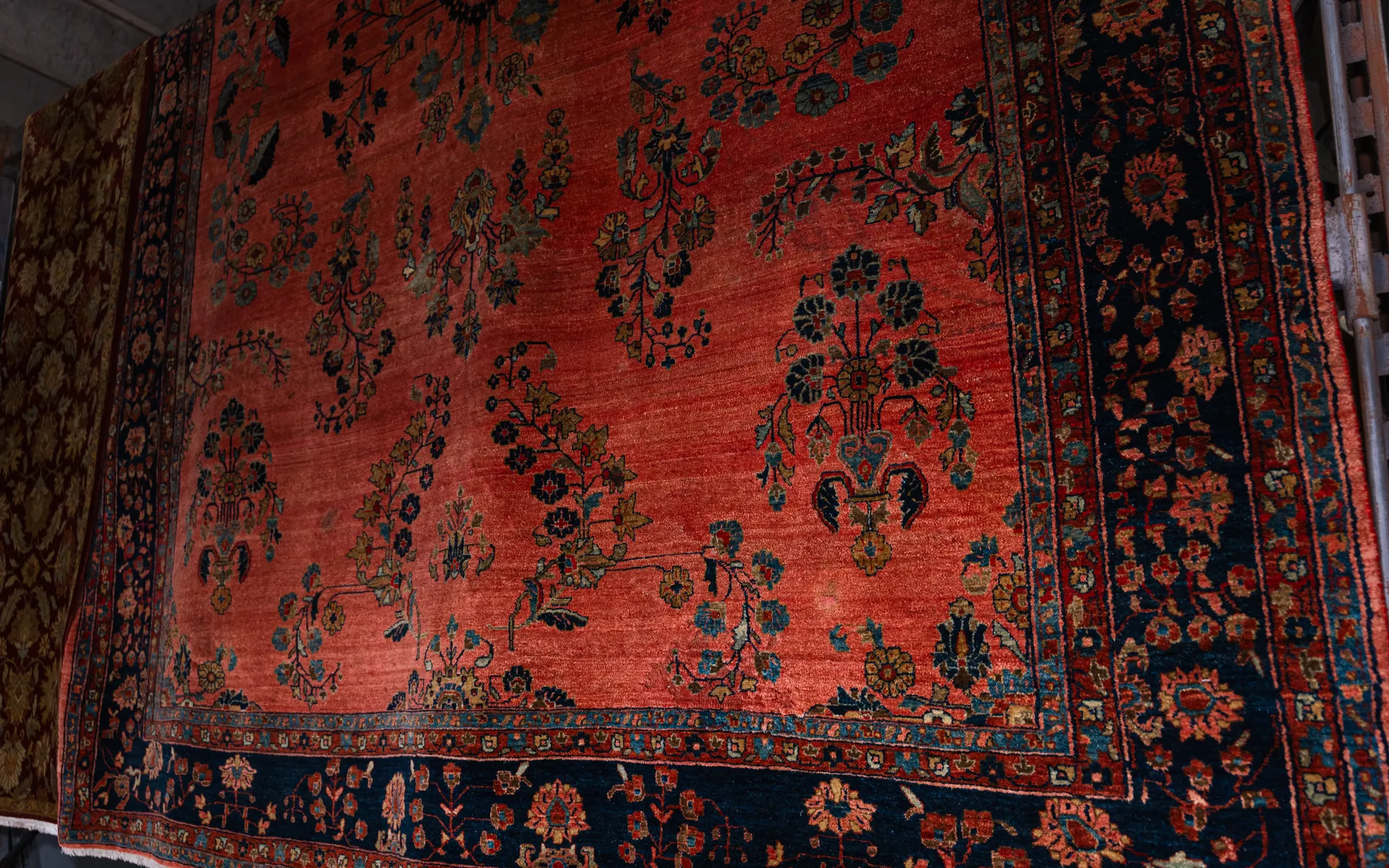
No wash can bring back color the sun has taken. In a bright climate like South Florida's, the practical way to prevent rug fading is to control how much light reaches the pile, for how long, and how evenly.
Why Do Rugs Fade in the Sun?
Rugs fade because light breaks down the dye molecules in the fibers, and the damage adds up with every hour of exposure.
Rug fading from sunlight is a matter of dose. Conservators measure light in lux, a unit for how much light falls on a surface, and treat the dose as light level multiplied by hours of exposure. The Canadian Conservation Institute (CCI) explains that halving either one halves the damage, and that light damage is cumulative and irreversible, so every sunny afternoon counts.
Ultraviolet (UV) light gets most of the blame, but visible light does much of the work. For light-sensitive colors, the CCI estimates that UV usually causes less than half of the fading and often only a tenth; UV dominates only for colors that already resist light well. UV does its own harm, though: it weakens wool, cotton and silk fibers and can eventually make them break apart.
Rule of thumb: filters cut UV, but only shade, distance and time cut the visible light that does much of the fading.
Which Colors Fade First: Natural or Synthetic Dyes?
Neither label settles it, because lightfastness, a dye's resistance to fading, varies from one dye to the next.
The CCI sorts colorants into sensitivity groups. Most plant-extract dyes, insect dyes such as cochineal and lac, early aniline synthetics and many cheap synthetic dyes sit in the most sensitive group. Madder reds fall in the middle, and indigo on wool is among the most durable. Here is how soon each group shows a just-noticeable fade, by CCI estimates:
| Sensitivity group | Rug dye examples | Near a window (about 5,000 lux) | Daylight (about 30,000 lux) |
|---|---|---|---|
| High | Most plant extracts; cochineal and lac; early anilines; many cheap synthetics | 5 days to 2 months | 1 day to 2 weeks |
| Medium | Madder (alizarin) reds | 2 months to 7 years | 2 weeks to 1 year |
| Low | Indigo on wool | 3 to 70 years | 6 months to 10 years |
The estimates assume eight hours of light a day, and the wide ranges reflect differences between dyes within each group. The CCI also warns that the most light-sensitive colors can disappear within as little as a few hours of direct sunshine.
Mixed colors can shift instead of simply paling. In a 2024 study published in Glass Structures & Engineering, a printed green made from yellow and cyan turned blue as the less stable yellow faded. A rug green dyed by layering a plant yellow over indigo can carry the same risk, because the CCI ranks most plant dyes among the most light-sensitive colorants and indigo on wool among the most durable.
How to Prevent Rug Fading in a Sunny Room
Cut the light that reaches the rug, cut the hours it gets, and spread whatever is left evenly.
- Map the sun patch. Note where direct sun lands in the morning, at midday and in late afternoon, then check again as the seasons change; the lower winter sun reaches farther into a room through south-facing glass.
- Place the rug, or its most valued part, outside that patch. For rooms without UV filters, the CCI advises placing objects where no direct light from the window can reach them.
- Shade the brightest hours. According to the CCI, solar screens, blinds, partially closed curtains and outdoor shutters, closed during peak daylight, reduce both fading and glare. Close them when you are out, too.
- Filter UV at the glass. Clear UV-filtering film, or laminated glass with a UV-blocking layer, removes much of the UV while keeping the view.
- Rotate on a schedule. Turn the rug 180 degrees with each change of season, and more often if one end sits in direct sun. Rotation does not shrink the total dose, but it spreads it so the rug fades evenly instead of in a stripe.
- Move furniture now and then. A sofa or chest that never moves leaves a sharp outline of unfaded color as the rest of the rug lightens around it.
Spray-on fabric UV protectants leave a product on the fibers. If you try one, check the label for your fiber, test it in an inconspicuous spot first, and skip it on silk, antique or naturally dyed rugs unless a professional agrees.
Do UV Window Film and Impact Glass Stop Sun Damage on Rugs?
They slow sun damage on rugs but cannot stop it, because they filter UV while letting visible light through.
Ordinary window glass filters short-wave UV, but conservators at the CCI do not consider that enough for the collections they protect. Laminated glass does more. The Building America Solution Center, a U.S. Department of Energy resource, describes impact glass as a laminated sheet sandwiched between glass panels, so if you have impact-resistant windows, you likely have laminated glass already.
| Glass or treatment | What it filters | What still gets through | Bottom line |
|---|---|---|---|
| Ordinary clear glass | Short-wave UV only | Longer-wave UV and visible light | Not enough on its own |
| Laminated glass, as in impact windows | Standard interlayers block UV up to about 360 to 380 nanometers; UV-blocking interlayers reach 400, the edge of visible light | Visible light, plus some long-wave UV with standard interlayers | Helps most with mid-sensitivity colors |
| Clear UV-filtering window film | Can block nearly all UV, according to the International Window Film Association | Visible light | Helps, but no film can eliminate fading |
| Blinds, solar screens, curtains, shutters | UV and visible light | Whatever passes when they are open | The only option here that cuts visible light |
The 2024 study tested several glass types outdoors through a summer. The least stable colors faded strongly within a short time under every glass tested, while mid-stability colors gained the most from extra UV blocking.
Is It Sun Fading or Just Dirt?
Look at where the color change sits: sun fading follows the light, while soil and crushed pile follow foot traffic.
- Sun fading: the change lines up with the window, the edges are sharpest where furniture shaded the rug, and when you part the pile, the tips look paler than the yarn at the base. On a hand-knotted rug, the back, which never sees light, usually shows the original shade.
- Soil: a gray, flat cast that is heaviest in walkways and near doors rather than under the window. The WoolSafe Organisation, a wool-care industry body, notes that color often changes over time through pile flattening or gradual soiling, and that a good professional cleaning will usually restore the appearance.
- Pile shading: patches that look lighter from one side of the room and darker from the other. This is an optical effect of pile lying in different directions, not lost color.
- Photo-bleached cream wool: move a chair off a natural cream rug and the spot beneath may look yellower. WoolSafe explains that the wool around it has photo-bleached lighter, and the covered patch catches up quickly once exposed.
- Something else: sharp-edged spots, drips or color loss where the sun never reaches point to another cause and deserve a professional look.
If soil is the culprit, cleaning usually brings the color back; see how often to clean area rugs.
Can Sun-Faded Rug Color Be Restored?
Real fading cannot be reversed, but color restoration can make it less noticeable, and look-alikes such as soil often clean up.
The CCI is blunt: there is no true recovery possible from faded colors. Washing removes soil, not fading, so a hand wash can brighten a dirty rug but cannot return dye that light has destroyed.
Color restoration means a restorer applies new color by hand to blend faded areas back into the design. Because it is new color rather than the original dye, the result depends on the rug, the fiber and the extent of the fading, so it is a case-by-case decision. Sun-weakened fibers are a separate problem: no treatment restores their strength, and badly worn areas may need repair or reweaving.
Our rug repair and restoration guide explains those options. At Bakers Rug Service, color restoration sits alongside fringe repair, hole reweaving and moth damage repair in our rug services, but prevention remains the easier path.
Why Is Florida Sun So Hard on Rugs?
Bright sun in every season, big windows and heat all push the same way, so Miami rugs need several defenses at once.
South Florida has no long, dim winter to give a rug a rest, and many homes are designed around light. High-rise condos in Brickell often have floor-to-ceiling glass, and waterfront homes in Miami Beach can take long, unobstructed sun.
Heat adds strain. The CCI notes that organic materials in sunlight can reach 40°C (104°F), and more when dark or under glass, and the 2024 glazing study advises keeping colored materials no warmer than room temperature. Skip long sessions airing a rug in direct sun on a balcony or patio.
Humidity is a separate threat. Our guide to rug care in Miami humidity, salt air and sun covers the moisture side, from air conditioning to mildew.
When to Call a Professional
Call a professional when the rug is silk, antique or valuable, when you cannot tell fading from soil, or when faded areas bother you enough to consider color restoration.
- Silk, antique and heirloom rugs, where light can weaken fibers as well as fade color
- Uneven color that the checks above do not explain
- Pile that feels dry or breaks easily in the sunniest area
Bakers Rug Service washes every rug by hand, one at a time, at our shop in the Kendall area, and offers free estimates with complimentary pickup and delivery across Miami-Dade, Broward and Palm Beach counties. If you are not sure whether a color problem comes from sun, soil or something else, ask us for a free estimate.
Frequently Asked Questions
Do LED lights or lamps fade rugs too?
Far less than sunlight, but bright light of any kind adds to the total dose. Canadian Conservation Institute figures put the UV output of white LEDs in the very low range, compared with very high for daylight. Visible light still fades sensitive dyes, so keep floor lamps and spotlights from shining on one part of a rug at close range for hours on end.
Does a rug in a dim room still fade?
Yes, just more slowly. Even at 50 lux, a level most people would call dim, the Canadian Conservation Institute estimates that the most light-sensitive colorants show a just-noticeable fade within roughly 1.5 to 20 years at eight hours a day. Moving a rug away from the window buys it time rather than immunity, which is why rotation still matters in shaded rooms.
Do dark rugs show sun fading more than light ones?
Usually, yes. Fading reads as lightening, and glass researchers note that it is easiest to see in dark colors, so a navy or burgundy field gives the change away sooner than ivory. The WoolSafe Organisation adds that how far a dyed rug fades depends on the shade, the depth of color and the intensity of the light. Pale rugs fade too; it is simply harder to spot.
Can UV window film harm my windows or void a warranty?
It can affect some windows, so check before installing. The Canadian Conservation Institute cautions that films may void the warranty on sealed insulating glass units, and the International Window Film Association advises asking your dealer whether low-E windows can take film. Film makers publish film-to-glass guidance for trained installers, a good reason to have film fitted professionally rather than as a weekend project.
Fading, Dirt or Something Else?
Describe your rug and where it sits, and we will help you sort out what you can handle at home and what calls for a hand wash, repair or color restoration. Estimates are free.
Sources
- Agent of Deterioration: Light, Ultraviolet and Infrared (Canadian Conservation Institute)
- Textiles and the Environment, CCI Notes 13/1 (Canadian Conservation Institute)
- Investigation of Color Protection of Laminated Glass by UV-Blocking Interlayers for Conservation Application (Glass Structures & Engineering, 2024)
- Windows Have Impact-Rated Glass, Fire-Resistant Glass, or Protective Coverings (Building America Solution Center, U.S. Department of Energy)
- Frequently Asked Questions (International Window Film Association)
- The Safe Way to Care for Your Wool Carpets and Rugs (The WoolSafe Organisation)