How to Clean a Persian Rug: What Is Safe at Home and What Is Not
What you can safely do for a Persian rug at home, from vacuuming and blotting spills to testing dyes and controlling moisture, and why a full wash belongs with a professional.
By Bakers Rug Service · Hand-washed rug care in Miami since 1940
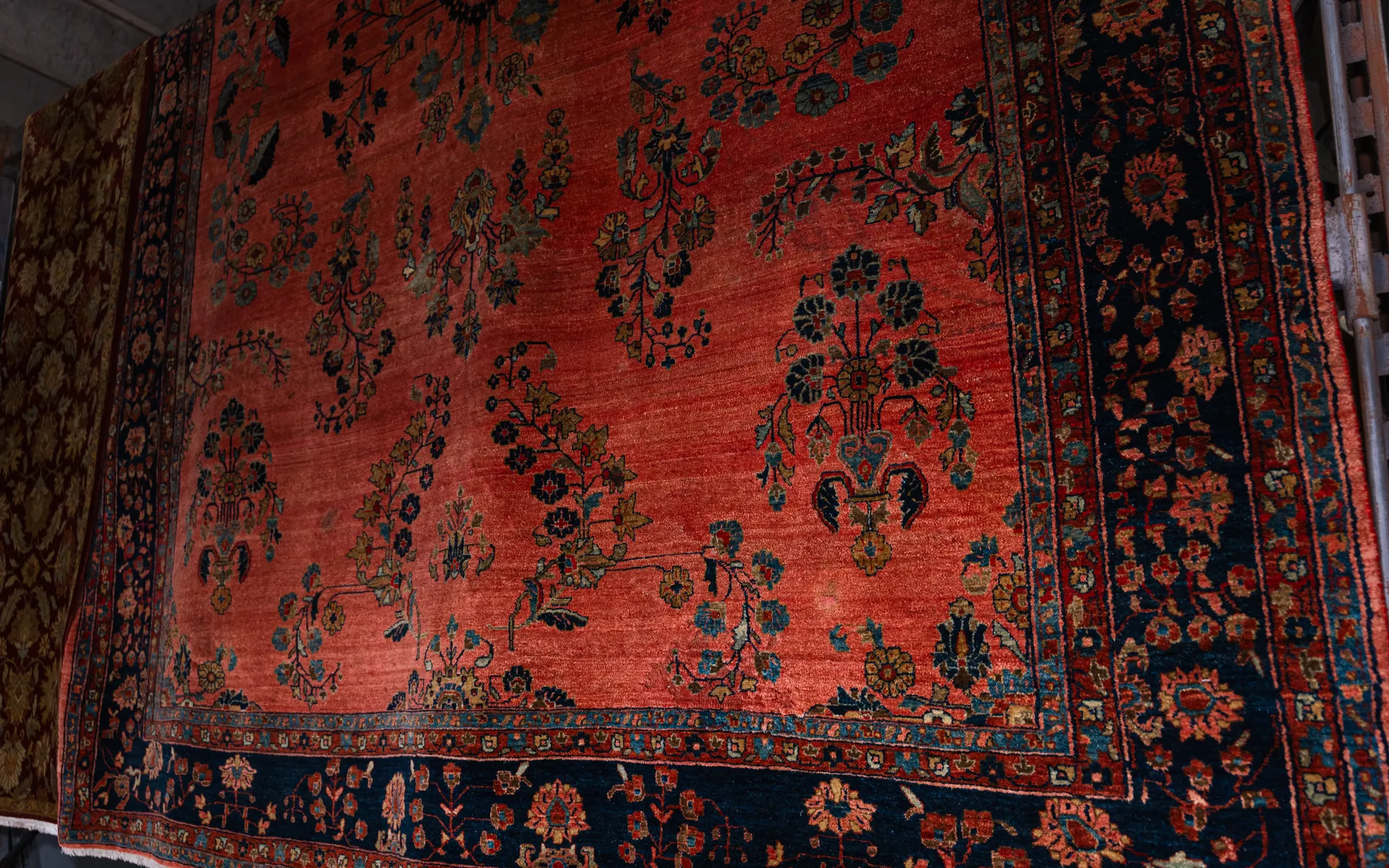
How to Clean a Persian Rug at Home (and What to Leave Alone)
The safest answer to how to clean a Persian rug is to split the job: you handle routine care at home, and a professional handles full washing, set-in stains and anything wrong with the fringe.
Here is how good Persian rug care divides up:
| Safe at home | Not safe at home |
|---|---|
| Vacuuming on suction only, in the direction of the pile | Beater bars, or vacuuming over the fringe |
| Blotting fresh spills with a white cloth and cool water | Scrubbing, hot water, bleach, ammonia or household detergents |
| Testing every color before using any product | Assuming an old or valuable rug is colorfast |
| Turning the rug end for end to even out wear and sun | Leaving one end in strong sun for years |
| Snipping a sprouted tuft level with the pile | Pulling loose tufts or fringe strands |
| Keeping the rug and the room dry | Hosing down, steam cleaning or shampooing the whole rug |
How Is a Persian Rug Made, and Why Does It Matter?
A Persian rug is a grid of foundation threads with thousands of short knots of dyed yarn tied around them, and every cleaning rule follows from that structure.
The foundation is two sets of threads: warp threads run the length of the rug, and weft threads cross them. Depending on where the rug was woven, the foundation may be cotton, wool or silk.
The weaver ties each knot of pile yarn around neighboring warps, row by row, and passes wefts between the rows to lock them in place. The cut ends of those knots form the pile, the surface you walk on.
Not sure what you own? Our guide to Persian, Oriental and Turkish rugs explains the differences. The same principles apply to Oriental rug cleaning at home, since hand-knotted Oriental rugs share this construction.
Two details shape how you clean:
- The fringe is the foundation. On a hand-knotted rug, the fringe is normally the warp threads leaving the ends, not a trim sewn on later. Damage it, and the last rows of knots can loosen.
- The dyes vary. A Persian rug may be colored with natural dyes, synthetic dyes or both, and its age or value tells you little about whether a color will hold when wet.
Why Does a Persian Rug Hold So Much Dirt?
Dry soil sifts down through the dense pile and settles at its base, around the knots and the foundation, where a quick pass of the vacuum barely reaches.
Tightly packed knots hide that grit well, so a rug can look clean while carrying a lot of it. The Canadian Conservation Institute points out that gritty particles have sharp edges that abrade and cut fibers when a textile moves, and a floor rug moves with every footstep.
Try the grit test. Over a hard floor, fold a corner back with the pile facing out and flex it, or tap the back a few times. If fine sand or dust falls out, soil has settled deeper than your vacuum reaches, and the rug is due for a professional wash.
How to Vacuum a Persian Rug Without Damaging It
Vacuum a Persian rug on suction only, moving in the direction of the pile and stopping short of the fringe.
- Turn off the brush roll. Use a suction-only setting or a plain floor tool. The Canadian Conservation Institute rules out beater bars on historic textiles, and a spinning brush easily grabs fringe.
- Find the direction of the pile. Run your palm along the rug: smooth is with the pile, rough is against it. Vacuum with the pile.
- Let suction do the work. Glide the nozzle without pressing down. If the rug lifts or an edge gets drawn in, lower the suction.
- Stop before the fringe. Lift the nozzle just before it reaches the fringe.
- Vacuum the back. When you rotate the rug, flip it and vacuum the reverse side too.
The Carpet and Rug Institute suggests vacuuming floor coverings at least once a week, more often in busy rooms or homes with pets; a fragile antique in a quiet room needs far less.
For fragile or antique rugs: the Canadian Conservation Institute vacuums historic textiles through a nylon or polyethylene screen on reduced suction, which keeps loose fibers and fringe out of the nozzle. Our guide to vacuuming an area rug walks through that screen method.
Fringe Care
Straighten the fringe with your fingers or a wide-tooth comb and keep vacuum brushes off it. Do not cut it shorter to tidy the ends, and never pull a loose strand. Thinning fringe or knots coming loose at the ends call for repair, not cleaning.
Rotation and Sunlight
Turn the rug end for end at regular intervals, more often in a sunny room, so wear and light spread evenly. Darker dyed wool fades with long exposure to sunlight, the WoolSafe Organisation notes, so draw blinds during the brightest hours.
How to Blot a Spill on a Persian Rug
Blot a spill with a plain white cloth and use nothing stronger than cool water until you have tested the dyes.
- Act quickly. Lift solids with a spoon or a blunt edge before adding any liquid.
- Blot, never rub. Press a dry white cloth or unprinted paper towel onto the spill, working from the edge toward the center and turning to a clean section as it absorbs. Rubbing distorts the pile and spreads the stain.
- Add cool water sparingly. Dampen the cloth, not the rug, and blot again until nothing more transfers.
- Pull out the moisture. Weigh down a half-inch stack of white paper towels with a flat object that will not bleed color, and change the towels as they get damp.
- Dry it with moving air. Run a fan across the area, and prop up the section if the spill reached the back.
If water alone fails, use only a spot cleaner made for wool, tested first; our wool rug cleaning guide covers how to choose and apply one. The WoolSafe Organisation warns that dish soaps and general household cleaners can cause rapid re-soiling and color bleeding on wool. Never use bleach, ammonia or other alkaline cleaners, hot water, laundry or dishwasher detergent, or a stiff brush.
Silk loses strength when wet, so on silk or silk-accented rugs blot with a dry cloth only; see how to clean a silk or viscose rug. A spill that went through to the back, a pet accident or a stain that has already dried is a job for a professional wash.
How to Test a Persian Rug for Dye Bleed
Test for dye bleed by wetting a hidden spot of each color, pressing a white cloth against it and checking the cloth for any trace of color before you clean.
Signs that dyes have already bled:
- Pink, red or blue tints creeping into ivory or pale areas
- Color in the fringe that matches the pile next to it
- Blurry edges where crisp borders used to be
Not every color change is bleed. Bands of slightly different shade running across the rug, called abrash, come from yarn dyed in separate batches and are normal in handmade rugs. Dyes that stay put when wet are called colorfast.
To run the test:
- Choose a hidden spot for each color, such as an area under furniture. One stable color tells you nothing about the others.
- Put a few drops of cool water, or the cleaner you plan to use, on the spot.
- Press a white cloth onto it for 10 seconds, as in the Carpet and Rug Institute's pretest, and check it. The Canadian Conservation Institute checks again at 2 and 5 minutes.
- Any color on the cloth means stop. Do not wet-clean that rug at home, and dry the spot with a cool fan.
A clean result is not the final word. The Canadian Conservation Institute calls the test not foolproof, because dyes can still run during a full wash or while drying, which is one reason a whole-rug wash needs controlled conditions.
How to Protect a Persian Rug From Moisture and Mold
Keep both the rug and the room dry: the EPA advises holding indoor humidity below 60 percent, ideally between 30 and 50 percent, and drying wet materials within 24 to 48 hours to prevent mold growth.
Wool pile and a cotton foundation both hold moisture, and the foundation can stay damp after the surface feels dry. In a humid climate like Miami's, run air conditioning or a dehumidifier, even in seasonal homes left closed up.
- Keep potted plants, vases and pet water bowls off the rug. Slow, repeated moisture under a pot can damage the foundation before it shows on the surface.
- Never lay a damp rug back on its pad or a wood floor. Our guide on how to dry a wet rug covers what to do first.
- Dry wet wool fast. The Carpet and Rug Institute advises quick drying to limit yellowing or browning.
When to Call a Professional for Persian Rug Cleaning
Call a professional when the rug needs more than surface care: a full wash, a set-in stain, dye bleed, a persistent odor, or damage to the fringe or edges.
Washing a whole Persian rug means wetting the pile and foundation, rinsing out every trace of detergent and then drying a heavy, waterlogged rug before mold can start. The Carpet and Rug Institute discourages do-it-yourself cleaning of area rugs made from natural fibers other than cotton, and wool tolerates neither the heat nor the agitation of household machines.
At Bakers Rug Service, every rug is washed by hand, individually, and never machine cleaned. The process has five steps:
- Expert inspection for dye stability, stains and structural damage
- Deep dusting to remove embedded dry soil
- A hand wash with gentle pH-neutral solutions
- Repair and detail when requested, such as fringe repair, rebinding edges or fixing holes
- Controlled air drying in a climate-controlled environment to prevent mold and shrinkage
Read how our hand-wash rug cleaning service works, or compare hand-washed and machine-washed rugs.
Pickup and delivery are complimentary across Miami-Dade, Broward and Palm Beach counties, including homes in Coral Gables and Coconut Grove. Call (305) 232-3368 or request a free estimate.
Frequently Asked Questions
Can I use a steam cleaner or carpet shampooer on a Persian rug?
It is not a good idea. Steam cleaners and rented shampooers drive hot water and detergent into the pile while their brushes agitate the wool, and they can leave moisture trapped in the foundation. On a hand-knotted rug that combination can cause shrinkage, fuzzing, dye bleed and slow, uneven drying. Keep these machines for synthetic floor coverings and leave a wool or silk rug's full wash to a hand-wash specialist.
Is vinegar or baking soda safe on a Persian rug?
Neither is a cure-all, and both need the same dye test as any cleaner. Diluted white vinegar is mildly acidic and appears in some spot-cleaning guides, but any liquid can move an unstable dye. Baking soda is mildly alkaline, wool is sensitive to alkalis, and powder worked into a dense pile is hard to vacuum back out. On a valuable rug, call a professional for anything plain water will not lift.
Why is the fringe on my Persian rug turning yellow or brown?
Fringe discolors for a few reasons. It sits at the ends of the rug, where it collects soil and gets caught by vacuums; dye from the neighboring pile can migrate into it when the rug gets wet; and wool or cotton that dries slowly can turn yellow or brown. Bleach only weakens the fibers. A professional wash can improve soiled fringe, but browning and dye stains may be permanent.
How can I tell if my rug is hand-knotted or machine-made?
Turn a corner over. A hand-knotted rug shows its pattern clearly on the back, with tiny knots that vary slightly in size and rows that are not perfectly even, and its fringe is the ends of the warp threads that run through the rug. Machine-made rugs usually have a very uniform back and fringe sewn onto the ends, while hand-tufted rugs have a cloth backing glued over the back.
How often does a Persian rug need professional cleaning?
It depends on traffic, pets and the room more than on the calendar. A rug in a busy hallway or a home with pets needs washing far more often than one in a guest bedroom. The Carpet and Rug Institute recommends restorative cleaning of installed carpet every 12 to 18 months and says rugs need it at regular intervals too. A failed grit test, dull colors or a lingering odor are signs it is time.
Not Sure What Your Rug Can Handle?
Tell us about your Persian rug through the contact form or call (305) 232-3368. We will help you decide what is safe to do at home and what needs a hand wash, starting with a free estimate.
Sources
- Mechanical Surface Cleaning of Textiles, CCI Notes 13/16 (Canadian Conservation Institute)
- Testing for Colourfastness, CCI Notes 13/14 (Canadian Conservation Institute)
- Carpet & Rug Care Guide (The Carpet and Rug Institute)
- The Safe Way to Care for Your Wool Carpets and Rugs (The WoolSafe Organisation)
- A Brief Guide to Mold, Moisture and Your Home (U.S. Environmental Protection Agency)
- The Painstaking Process of Tying 15.5 Million Knots (LACMA Unframed)