Antique Rug Care: Preservation Basics and When to Get an Appraisal
Protect an antique or heirloom rug from light, humidity, pests and risky cleaning, learn how to roughly tell if it is antique, and see when an appraisal is worth getting.
By Bakers Rug Service · Hand-washed rug care in Miami since 1940
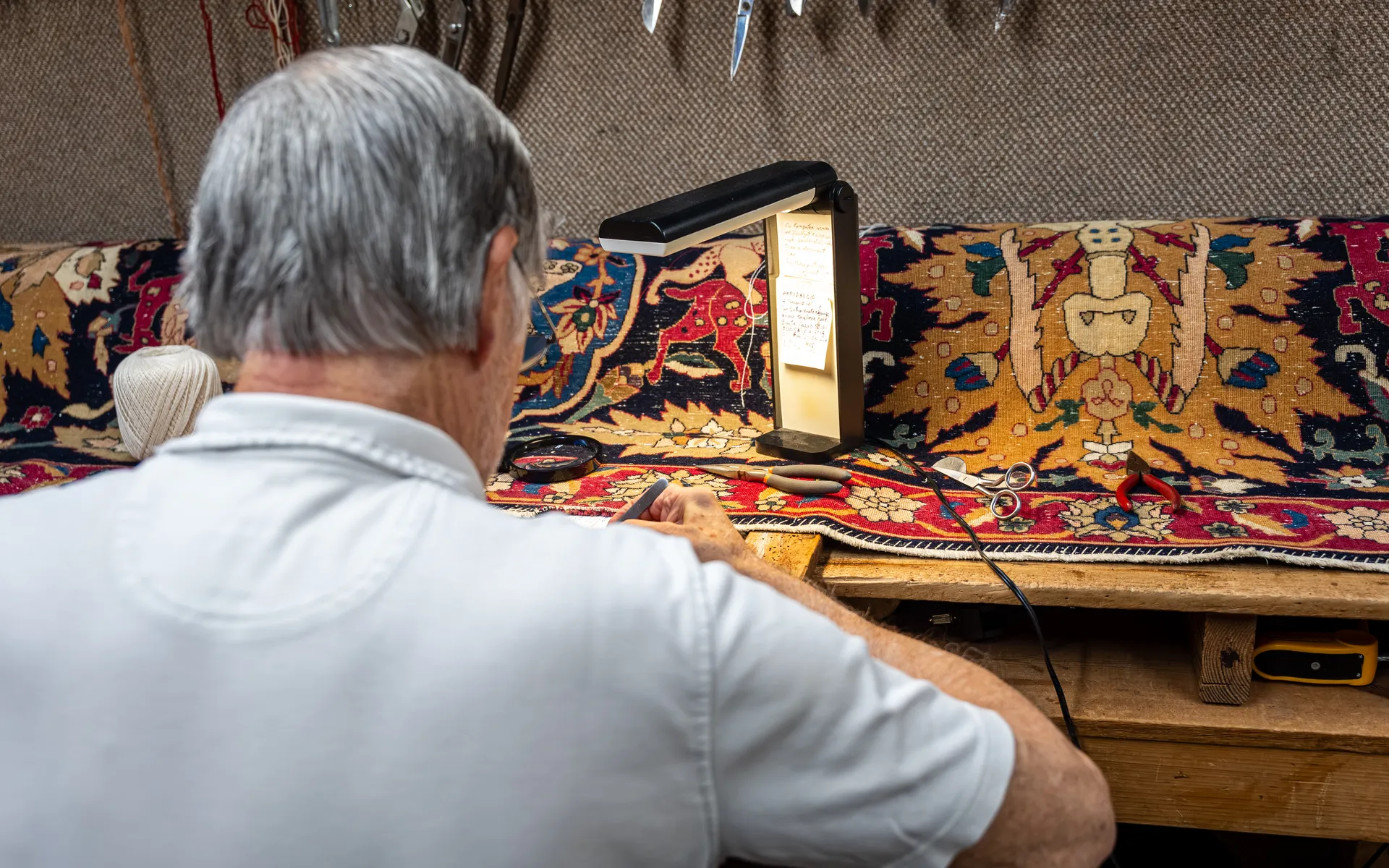
Antique rug care is mostly about avoiding damage you can't reverse, because an old rug's dyes, wool and foundation have already absorbed decades of light, traffic and humidity. The basics below come from two textile conservation bodies, the Canadian Conservation Institute (CCI) and Icon, the UK's Institute of Conservation, followed by how to roughly tell if a rug is antique and when an appraisal is worth getting.
Two terms first: the foundation is the grid of warps (lengthwise threads) and wefts (crosswise threads), and the pile is the surface of cut yarn knotted around the warps.
Antique Rug Care Basics: Light, Wear, Humidity, Heat and Pests
The core of antique rug care is slowing five gradual threats: light, uneven wear, humidity, heat and insects.
| Threat | What it does | What to do |
|---|---|---|
| Light | Sunlight and artificial light fade dyes and weaken fibers; silk is the most vulnerable | Avoid direct sun; close blinds in the brightest hours |
| Uneven wear | Traffic paths and furniture wear some areas faster | Turn the rug around every year or two |
| Humidity | Relative humidity over 65 percent encourages mold, and damp can make colors bleed | Keep the air conditioning on and check a hygrometer |
| Heat | Heat dries wool and draws out its natural oils, weakening the yarn | Keep the rug away from heaters and fireplaces |
| Moths and carpet beetles | Larvae eat wool, leaving irregular holes, cocoons and gritty deposits | Clean under furniture, check beneath the rug and inspect stored rugs yearly |
In South Florida, watch humidity most closely: keep a hygrometer (a small gauge that reads relative humidity) in the room, and if you close the home for the summer, leave the air conditioning running. If you find live insects or fresh damage, Icon advises wrapping the rug in polyethylene to isolate it from other textiles and contacting a conservator; our guide to preventing moths and carpet beetles covers the rest.
How Should You Move and Vacuum an Antique Rug?
Move an antique rug by rolling it rather than dragging it or lifting one edge, and vacuum it slowly with plain suction.
CCI warns against grabbing one edge of a large rug; instead, roll up a section and pull gently with both hands. Lift furniture onto the rug rather than dragging it across. Icon recommends rolling a large carpet in the direction of the pile around a wide tube, with two or three people.
For vacuuming, the two bodies describe a gentle routine:
- Use a plain suction head on low suction, never a power head with a spinning brush.
- Work slowly in the direction of the pile, without pressing or rubbing.
- Keep the nozzle off the fringe and away from loose threads.
- On worn patches, Icon suggests a small hand-held vacuum with no brush and a piece of net tied over the nozzle.
- Now and then, vacuum the rug's back, the pad and the floor.
If the rug is already fragile, Icon advises asking a conservator before vacuuming at all, because vacuuming may make the damage worse. Putting the rug away for a season? Follow our guide on how to store a rug.
What Rug Pad Is Safe Under an Antique Rug?
A thin, full-size pad with no adhesive is the safe choice, because it cushions the rug and keeps it flat without sticking to it.
CCI's guidance is specific: an underlay should be 1/8 to 1/4 inch (3 to 6 mm) thick, reach the edges of the rug, and never be folded or overlapped. It lists self-adhesive pads, foam rubber, vinyl, jute and recycled felt as materials to avoid. Icon likewise rules out rubber, synthetic foam and anything containing adhesive, and prefers polyester, because natural fibers such as wool and hair can attract insects.
Icon also cautions against laying rugs directly on stone floors because of damp, worth noting in homes with tile or stone. Replace any pad that is damaging the rug. Bakers Rug Service cuts non-slip pads to size; for an antique, ask what a pad is made of first, and see how to choose a rug pad.
Why Should an Antique Rug Be Washed Only by a Professional?
Leave washing to a professional, because wet cleaning can't be undone and an old rug's dyes and foundation can react in ways that are hard to predict at home.
Icon puts it plainly: wet cleaning is irreversible, and whether a rug can be washed at all depends on its condition, what it's made of and whether its dyes will run. Icon also says steam cleaning and carpet shampoos are not suitable for handmade rugs, and CCI notes that commercial shampoos can leave a rug attracting more dirt.
For a spill, blot right away with a clean white cloth, dabbing rather than rubbing, then weight clean absorbent material over the spot until it dries, as CCI suggests.
At Bakers Rug Service, every rug is washed by hand, individually, never by machine. The work starts with an expert inspection for dye stability, stains and structural damage, followed by deep dusting to remove embedded dry soil, a hand wash with gentle pH-neutral solutions, any requested repair and detail work, and controlled air drying in a climate-controlled environment to prevent mold and shrinkage. See our rug washing and repair services for details.
How to Know If a Rug Is Antique
Under the federal tariff schedule, an antique is an article made 100 or more years before the date of entry; you can screen a rug yourself, but dating it with confidence takes an expert.
The Harmonized Tariff Schedule, the federal list used to classify imports, places "antiques of an age exceeding 100 years" under heading 9706, with a separate line for pieces over 250 years. A few checks will tell you whether a closer look is worthwhile:
- Check how it was made. Hand-knotted, tufted and machine-made rugs look different on the back and at the fringe; our guide to Persian vs. Oriental vs. Turkish rugs walks through those checks. Construction narrows the field, but it does not date a rug.
- Gather the paper trail. Receipts, an earlier appraisal, shipping or customs papers and family photos showing the rug in a room can all help place its age.
- Read wear with caution. Thin pile and old repairs can suggest a long life, but heavy use can wear a much younger rug the same way.
Handmade doesn't mean old, either; hand-knotted rugs are still woven today.
Does Older Mean More Valuable?
Not necessarily: age is only one factor, and condition, restoration, rarity and demand often matter as much.
Federal tax rules value property at fair market value, the amount a willing buyer and a willing seller would agree on when neither is forced to act and both know the relevant facts. IRS Publication 561 says the physical condition and extent of restoration are both relevant to the value of art and antiques, and its guidance on collectibles such as coins names demand, age, rarity and condition. A 100-year-old rug with dry rot (foundation threads weakened by long exposure to moisture) or heavy moth damage may be worth less than a younger rug in excellent condition.
Before an appraisal, leave the rug as it is: no trimming the fringe, gluing a loose edge or home repairs. If restoration makes sense, weigh the appraisal and a repair estimate together; our rug repair and restoration guide explains the common repairs.
What Does an Antique Rug Appraisal Cover?
An antique rug appraisal is a written opinion of value for a stated purpose: it identifies the rug, records its condition and states which kind of value it reports.
IRS Publication 561's requirements for a qualified appraisal of donated property make a useful checklist for any written appraisal:
- A description detailed enough to identify the rug
- Its physical condition
- The date the value applies to
- The value, the method used to reach it and the basis, such as comparable sales
- The appraiser's name and qualifications
- For art objects, a professional-quality color image
Purpose decides which value is reported:
| Situation | Value usually reported | Why it matters |
|---|---|---|
| Insuring the rug | Replacement cost | Items must be professionally appraised before you buy a floater policy |
| Settling an estate | Fair market value | Estates filing a federal return need an expert appraisal under oath once valuables such as antiques and oriental rugs pass a set total |
| Donating the rug | Fair market value | The IRS requires a qualified appraisal for larger noncash gifts |
| Dividing heirlooms or selling | Fair market value | Heirs or a seller start from the same independent figure |
The IRS notes that in most cases there is no relationship between replacement cost and fair market value, so one kind of appraisal can't stand in for the other. Ask your insurer whether your policy limits coverage on valuables.
Bakers Rug Service offers appraisal services. Tell us what the appraisal is for when you ask, and for a tax or estate filing, confirm with your attorney or tax adviser which appraiser qualifications they need. Our antique rug appraisal guide looks at the factors appraisers weigh, from knot counts to dyes.
When to Call a Professional
Call a professional before any wet cleaning or repair of an antique rug.
Call as soon as you notice any of these:
- Moth or carpet beetle signs: irregular holes, cocoons or gritty deposits
- A musty smell, colors bleeding, or stiff, brittle patches on the back
- Loose fringe, unraveling edges or new holes, which tend to grow with foot traffic
- A significant spill or pet accident that blotting didn't fully lift
- Plans to insure, divide or donate the rug
Heirloom rug care rewards early attention. Bakers Rug Service, at 8723 SW 132 St in the Kendall area, hand-washes and repairs Persian, Oriental, Turkish, wool and silk rugs and offers appraisal services. Estimates are free, and pickup and delivery are complimentary across Miami-Dade, including Coral Gables and Coconut Grove, as well as Broward and Palm Beach counties.
Not sure whether your rug needs a wash, a repair or an appraisal first? Tell us about your rug and we'll give you a clear, free estimate before you commit to anything.
Frequently Asked Questions
Can I hang an antique rug on the wall?
Yes, if the weight is spread along the whole top edge. CCI describes hand-stitching a cotton sleeve carrying Velcro to the top of the rug, with the matching strip on a wooden batten, and lining the back with prewashed cotton against dust. Icon advises against hanging a rug on an outside wall, which can be damp, and CCI notes that pests can hide between a rug and its lining.
What do semi-antique and vintage mean on a rug listing?
The U.S. tariff schedule only sets lines for antiques over 100 and over 250 years, so semi-antique and vintage are seller terms used loosely for younger rugs. Ask the seller for an approximate date and how it was established, whether from paperwork, construction details or an appraisal, and get that answer in writing before you pay extra for age.
Will restoring an antique rug lower its value?
It depends on the work. Stabilizing repairs, such as securing a loose edge or fraying fringe, keep small problems from spreading with foot traffic. Heavier restoration replaces more of the original rug, so for a valuable piece, get an appraisal before you decide and ask the restorer to explain exactly what will be rebuilt and what will be kept. File the written estimate with your records.
What records should I keep for an antique rug?
Keep clear photos of the front, the back and any labels or damage, the rug's measurements, and every receipt, appraisal and cleaning or repair invoice. Keep copies outside the house or in the cloud. Records like these support an insurance claim, simplify an estate inventory and give a future appraiser useful history about where the rug came from and what has been done to it.
How often should an antique rug be professionally washed?
There is no fixed schedule. A rug in a quiet room that is vacuumed gently can go longer between washes, while one in a dining room, entryway or home with pets needs attention sooner. Visible soil, a dull or gritty feel, odors and spills are the usual signals. Have the rug inspected first, because its condition decides whether washing is safe at all.
Know What Your Antique Rug Needs First
Tell us about your rug and we'll give you a clear, free estimate for washing, repair or appraisal services before you commit to anything. Pickup and delivery are complimentary.
Sources
- Basic care: Carpets and rugs (Canadian Conservation Institute)
- Carpets and Rugs, Caring for Your Treasures (Icon, The Institute of Conservation)
- Harmonized Tariff Schedule, heading 9706: Antiques of an age exceeding 100 years (U.S. International Trade Commission)
- Publication 561, Determining the Value of Donated Property (Internal Revenue Service)
- 26 CFR 20.2031-6, Valuation of household and personal effects (Legal Information Institute, Cornell Law School)
- Special coverage for jewelry and other valuables (Insurance Information Institute)