Hand Washed Rug Cleaning vs. Machine Washing: Why the Method Matters
Agitation, water temperature, dye testing, rinsing and drying decide whether a rug comes back clean or changed. Here is what a hand wash controls, and how to vet any cleaner.
By Bakers Rug Service · Hand-washed rug care in Miami since 1940
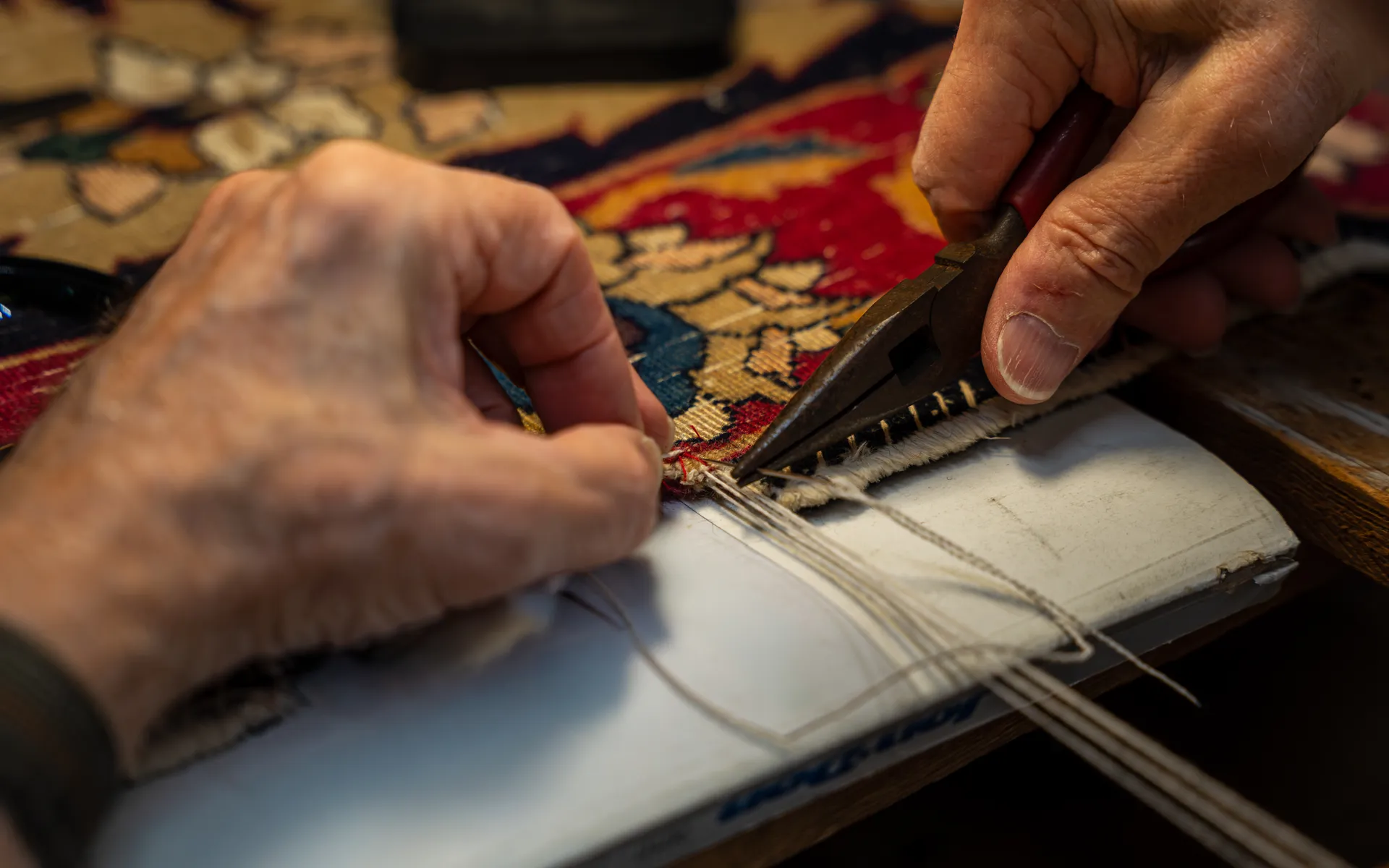
Hand washed rug cleaning and a machine wash can both make a rug look brighter the day it comes back. The difference shows up later: a wool pile turned dense and fuzzy, a red that has crept into the ivory, or a musty smell that will not leave. Each traces back to one of five things the method controls: agitation, water temperature, dye stability, rinsing and drying. Here is what a careful hand wash does with each, and how to check any cleaner's method before you hand over a rug.
What Is the Difference Between Hand Washed and Machine Washed Rugs?
The difference is who sets the process: in a hand wash a person adjusts each step to one rug, while a machine runs the same program on whatever goes into it.
- Machine washing means a cycle the equipment controls, as in a home or laundromat washing machine. The program decides how long the rug tumbles, how warm the water gets, how many rinses it receives and how hard it spins.
- Hand washing rugs means working on one rug at a time, with a person choosing the solution, the water temperature and how much the pile is worked, section by section, while watching the dyes.
Carpet-cleaning machines such as rental extractors and so-called steam cleaners are a separate category, compared in our guide to professional rug cleaning vs. steam cleaning vs. DIY.
One caution about the label itself: Consumers' Checkbook, a nonprofit consumer organization, notes that hand wash is a generic term used by almost all rug cleaning companies, and advises asking each one to describe in detail what it does.
Why Hand Wash a Rug? Five Variables a Machine Cycle Does Not Adjust
Hand wash a rug when its fiber, dyes or age mean that agitation, water temperature, dye stability, rinsing and drying each need to be set for that rug, not for a load.
| Variable | Fixed machine cycle | Careful hand wash |
|---|---|---|
| Agitation | Tumbling at the strength the program sets | Pile worked gently by section, never wrung |
| Water temperature | Whatever the dial is set to | Room temperature to lukewarm, matched to the dye test |
| Dye stability | Every color gets wet at once | Each color tested before the full wash |
| Rinsing | A fixed number of rinses | Rinsed until the water runs free of detergent |
| Drying | Left to the owner or a tumble dryer | Controlled air drying, checked through to the base |
Agitation
Agitation is the rubbing, tumbling or brushing that loosens soil, and on wool it can change the rug for good. The Woolmark Company, a wool industry organization, explains that untreated wool fibers carry microscopic surface scales. Heat and moisture lift them, and mechanical agitation makes them lock onto neighboring fibers in a ratchet-like way.
That process is felting. Woolmark describes it as irreversible, causing fiber entanglement, densification and shrinkage. The Canadian Conservation Institute (CCI), a Government of Canada agency, adds that textiles are weaker when wet and should never be rubbed or squeezed during washing.
Water Temperature
Hot water is not what gets a rug clean, and it raises the risk for wool and older dyes. For washing undyed historic textiles, CCI specifies water at room temperature or slightly warmer, 25 to 35 degrees C (77 to 95 degrees F). Consumers' Checkbook warns that on antique and semi-antique rugs, warm water can cause dyes to run.
CCI runs its dye test with water at the planned wash temperature, so the test matches the wash. Colors that held in a cool test have not been cleared for a hot cycle.
Dye Stability
Colorfastness is a dye's resistance to running when wet. CCI calls washing an irreversible treatment, so it tests every color in a small, unobtrusive spot first, with purified water and then the detergent solution, under blotting paper. Any color on the blotter rules the wash out.
A clean test still has limits: CCI cautions that dyes can run unexpectedly during washing or drying, so a hand washer watches the colors to the end. A washing machine wets every color at once, with no point to stop partway. For a test you can do yourself, see how to clean a wool rug.
Rinsing
Rinsing carries loosened soil and detergent out of the pile, and a set program rinses by count, not by result. In CCI's guidance, a textile is rinsed typically four to six times, or until all of the detergent is out, and the final rinse water should closely resemble clean distilled water in clarity and bubble formation.
Drying
Drying is where a good wash is most often undone, especially in South Florida's humid air. The U.S. Environmental Protection Agency (EPA) says that when wet or damp materials are dried within 24 to 48 hours, in most cases mold will not grow, and advises keeping indoor humidity below 60 percent, ideally between 30 and 50 percent.
Wool makes the check harder. The University of Waikato's Science Learning Hub notes that wool can absorb up to 30 percent of its weight in water without feeling wet, so a dry-feeling surface is no proof that the foundation, the woven base that holds the pile, is dry. CCI's guidance is to dry a washed textile quickly, with fans on a cool setting if needed, and never to store it until it is completely dry. Our guide on how to dry a wet rug covers the home version.
What Does Hand Washed Rug Cleaning Involve?
At Bakers Rug Service, hand washed rug cleaning follows five steps, each aimed at the variables above, and every rug is washed by hand, individually.
| Step | What happens | What it controls |
|---|---|---|
| 1. Expert inspection | Dye stability, stains and structural damage are assessed before the rug gets wet | Dye stability, and whether a full wash suits the rug |
| 2. Deep dusting | Embedded dry soil, dust mites and allergens are removed | Dry soil comes out before water goes in |
| 3. Hand wash | Washed by hand with gentle pH-neutral solutions | Agitation, temperature and chemistry |
| 4. Repair and detail | Fringe repair, rebinding edges and fixing holes, when requested | Weak points found at inspection |
| 5. Controlled drying | Air drying in a climate-controlled environment to prevent mold and shrinkage | Drying |
Dusting comes first for the same reason CCI vacuums a textile before washing it: to remove surface dust before the textile gets wet. pH-neutral means neither acidic nor alkaline. The Science Learning Hub notes that part of the wool fiber is susceptible to chemical attack from strong alkaline conditions, which is why a pH-neutral detergent is recommended.
Our rug washing, repair and restoration service covers Persian, Oriental, Turkish, wool and silk rugs, plus pet stain and odor treatment.
Which Rugs Need Hand Washing, and Which Can Go in the Machine?
Start with the care label: a rug made and labeled as machine washable can follow its maker's instructions, while wool, silk, handmade and antique rugs should stay out of the washing machine.
- Machine washable by label. Follow the stated temperature, cycle and drying instructions exactly.
- Hand wash or professional only. Wool and wool-blend rugs, silk and viscose (see our silk and viscose guide), hand-knotted and hand-woven rugs, antiques, and any rug whose colors moved in a test.
- No label at all. Treat it as hand-wash only until someone has inspected the fiber and dyes.
Machine-made describes how a rug was constructed, not how it should be cleaned. An untreated wool pile felts the same way whether it was knotted by hand or woven on a power loom.
What Does Machine Rug Cleaning Damage Look Like?
The usual signs of machine rug cleaning damage are bled colors, wool that feels denser or measures smaller than before, and dampness or a musty smell that lingers.
- Bled colors. Dye ghosting into lighter areas or the fringe means colors moved during washing or drying.
- Felted or shrunken wool. A matted, compacted pile or a rug that has lost size is the densification and shrinkage Woolmark describes.
- Lingering dampness. A rug still damp after two days has stayed wet past the EPA's 24 to 48 hour window.
Already seeing damage? Do not wash the rug again to fix it. If it is still damp, lay it flat with cool air moving across it, then have it inspected.
Before a rug leaves your home, measure it and photograph both sides so you have something to compare against. Consumers' Checkbook also suggests getting a receipt that records the rug's type, size and description. For the questions to ask before you book, see how to choose a rug cleaner in Miami.
When Should You Call a Professional?
Call a professional before washing any rug that is wool, silk or viscose, handmade or antique, has dyes that moved in a test, or cannot be dried through to its foundation within 24 to 48 hours.
The same goes for a rug already showing bled colors or felting. Bakers Rug Service offers free estimates and complimentary pickup and delivery across Miami-Dade, Broward and Palm Beach counties, from Coral Gables to Palmetto Bay. Rugs are washed at the shop at 8723 SW 132 St, Miami, FL 33176, in the Kendall area.
Want to know how your rug would be washed before you commit? Request a free estimate through our contact form and we can walk you through each step.
Frequently Asked Questions
Is hand washing safe for every rug?
No method suits every rug, and some should not be fully washed at all. The Canadian Conservation Institute advises that textiles that are fragile, fragmenting or powdering should not be washed. A careful cleaner inspects first and will tell you when a rug is too weak, or its dyes too unstable, for a full wash, and what the gentler alternatives are before any work begins.
Can I hand wash a wool rug myself?
Sometimes, if the rug is small, sturdy and its colors pass a test. Use cool or room-temperature water and a gentle pH-neutral wool wash, work the pile lightly without wringing, rinse thoroughly and dry it flat with moving air. Large, dense, antique or silk rugs are a different job. If you cannot dry the rug through to its foundation within a day or two, have a professional handle it.
Can felting or dye bleeding from a machine wash be reversed?
Felting cannot be undone: Woolmark describes the scale interlocking behind it as irreversible. Bled dye is less predictable, because the outcome depends on the dye and how far it has traveled, and washing the rug again at home can move more color. Color restoration is one of our repair services, and a free estimate shows what can realistically be improved before you commit.
Who hand washes Persian and wool rugs in Miami?
Bakers Rug Service hand washes Persian, Oriental, Turkish, wool and silk rugs at its shop at 8723 SW 132 St in the Kendall area of Miami. Each rug is inspected, dusted, washed by hand individually and air-dried in a climate-controlled space. Free estimates and complimentary pickup and delivery across Miami-Dade, Broward and Palm Beach counties can be arranged through the contact form.
See How Your Rug Would Be Washed First
Tell us about your rug and we will explain the inspection, wash and drying it needs, with a free estimate before you commit. Pickup and delivery are complimentary across Miami-Dade, Broward and Palm Beach.
Sources
- Testing for Colourfastness, CCI Notes 13/14 (Canadian Conservation Institute)
- Washing Non-coloured Textiles, CCI Notes 13/7 (Canadian Conservation Institute)
- Machine Washable Wool (The Woolmark Company)
- Wool Fibre Properties (Science Learning Hub, University of Waikato)
- A Brief Guide to Mold, Moisture and Your Home (U.S. Environmental Protection Agency)
- Area Rug Cleaning (Consumers' Checkbook)