Persian vs Oriental Rug vs Turkish Rug: How to Tell the Difference
Persian, Oriental and Turkish are not three rival types. Learn what each name means, how to read knots, fringe and backing, and why construction, not origin, decides how a rug is cleaned.
By Bakers Rug Service · Hand-washed rug care in Miami since 1940
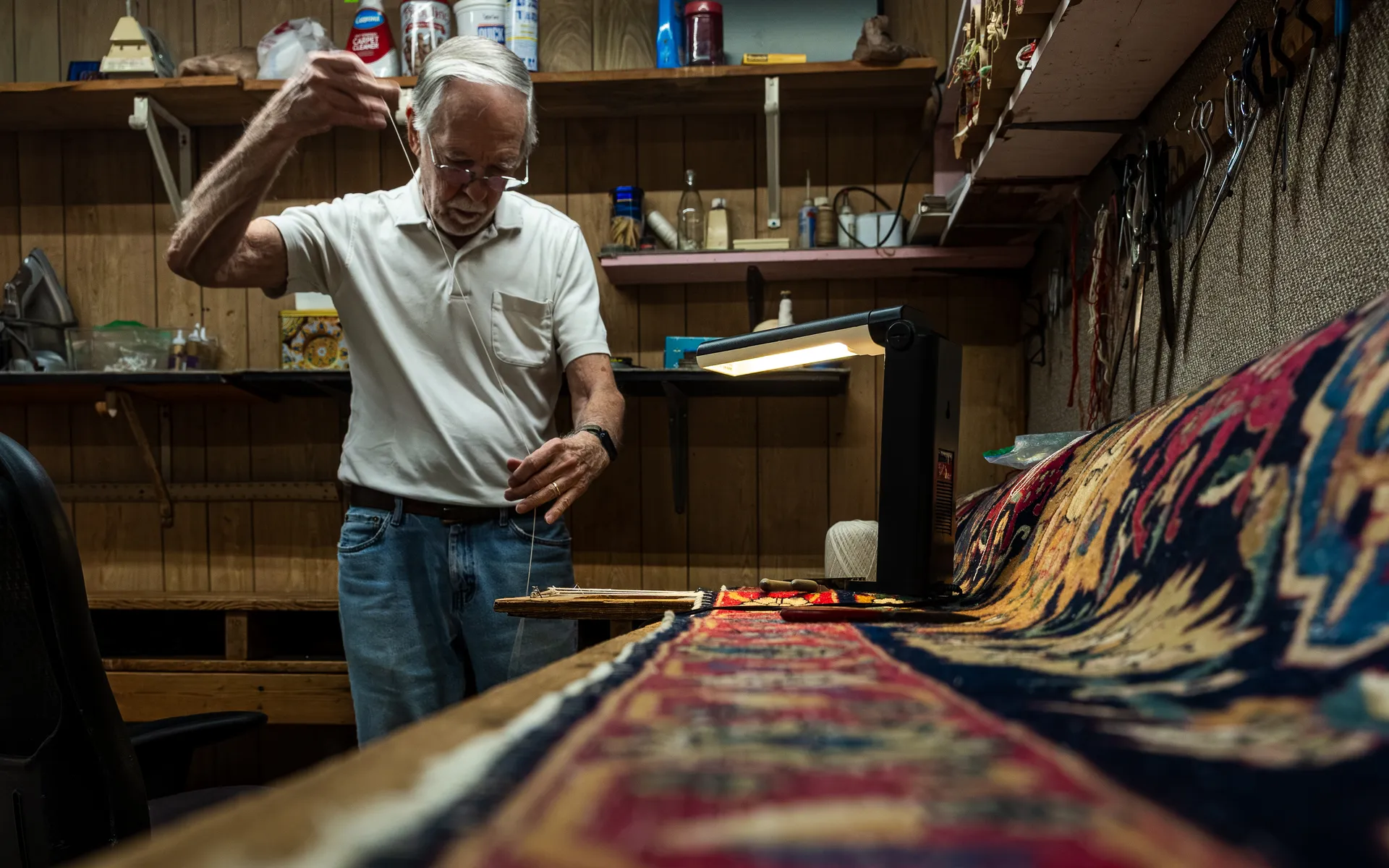
The Persian vs Oriental rug question confuses many owners because the two words are not rivals. "Oriental" is the umbrella, "Persian" is one family under it, and Turkish rugs are another. This guide shows how to tell them apart with your own eyes, how to spot a hand-knotted rug in a couple of minutes, and why the answer changes how a rug should be cleaned.
Persian vs Oriental Rug: What Do the Names Actually Mean?
Every Persian rug is an Oriental rug, but not every Oriental rug is Persian.
The difference between Persian and Oriental rugs is one of scope: Merriam-Webster defines an Oriental rug as a handwoven or hand-knotted one-piece rug made in a country of central or southern Asia. In everyday and trade use the label is looser and usually takes in Turkish rugs too.
- Oriental rug: a broad term for handmade rugs from Asia. Rugs from Iran, Turkey, the Caucasus, Central Asia, India and China are all commonly sold under it.
- Persian rug: a rug woven in Iran, historically called Persia. Used strictly, the word describes where a rug was made, not just how it looks.
- Turkish rug: a rug woven in Turkey, much of it in Anatolia, the Asian part of the country.
| Term | What it tells you | What it does not tell you |
|---|---|---|
| Oriental | A broad region and, traditionally, handmade work | The country, the fiber or the quality |
| Persian | Woven in Iran, when used strictly | The age, the dyes or whether the label is accurate |
| Turkish | Woven in Turkey | Whether it is hand-knotted, flat-woven or machine-made |
| Persian-style or Oriental-style | The design | Where or how it was made |
Turkish Rug vs Persian Rug: What Differences Can You See?
The clearest visible differences are in the knot, the drawing of the design and the foundation, and none of them is proof on its own.
The knot
A pile rug is made by tying short lengths of yarn around the warps, the lengthwise threads of the foundation, then cutting the ends to form the pile. There are two basic types, each tied to a pair of warps:
- Symmetrical knot, long called the Turkish or Ghiordes knot: the yarn wraps both warps of a pair the same way, and its two ends rise together between them.
- Asymmetrical knot, long called the Persian or Senneh knot: the yarn wraps one warp fully and passes behind its neighbor, so the two ends rise on different sides of a warp. It can open to the left or the right.
Encyclopaedia Iranica points out that both knots are used throughout the Near and Middle East, regardless of borders or the weavers' ethnic background, and both appear in rugs woven in Iran. A knot type narrows the field. It never settles the question by itself.
The drawing
The knot shapes how a design can be drawn. A past gallery label at the V&A in London notes that the symmetrical knot lends itself to straight, angular lines, and calls the V&A's Ushak carpet from Turkey, made around 1500, surprisingly curvilinear for a Turkish carpet. As a broad tendency, many Turkish and village rugs read as bold and geometric, while many Persian workshop rugs show flowing vines and finely drawn medallions. Exceptions run in both directions.
The foundation
Look at the fringe and the back. Encyclopaedia Iranica notes that finer Persian workshop carpets generally use undyed cotton warps, because cotton is less elastic and holds its shape better. The Ushak carpet, by contrast, is wool throughout: warps, wefts and pile. A wool foundation alone, though, does not point to one country.
How to Identify a Persian Rug (Not Just a Persian Design)
To identify a Persian rug, first confirm it is hand-knotted, then look for evidence of where it was woven, because the design name alone proves nothing.
Work through these steps:
- Read any label or tag. Note the country of origin it lists, keeping in mind that labels can be wrong. A Persian design woven elsewhere is a Persian-style rug.
- Confirm it is hand-knotted using the checks in the next section. A machine-made rug can carry a Persian pattern, but it is not a Persian rug in the strict sense.
- Treat place names as design names. Kashan, Nain, Qom, Tabriz, Heriz and Kerman are real weaving centers in Iran, but their names are also used for patterns woven in other countries.
- Use the knot and foundation as supporting clues. An asymmetrical knot on cotton warps fits many Persian workshop rugs, yet the same structure appears elsewhere.
- Look for paperwork. Receipts, import documents and earlier appraisals carry more weight than any single visual clue.
If what you really want to know is age, authenticity or value, that is a job for an appraisal, not a checklist. Our guide to antique rug care and appraisal explains what an appraiser examines.
Hand-Knotted vs. Machine-Made: How Can You Tell?
Turn the rug over: a hand-knotted rug shows its pattern clearly on the back, built from rows of small knots with slight irregularities.
Then compare the details:
| Check | Hand-knotted | Hand-tufted | Machine-made |
|---|---|---|---|
| Back | Pattern visible, knots in rows, small irregularities | Hidden under a cloth or canvas backing | Pattern visible but very even and grid-like |
| Fringe | The warp ends, coming straight out of the rug body | Usually sewn or glued on | Usually sewn on |
| Sides | Overcast or wrapped by hand | Bound edge | Machine-stitched or bound edge |
| Pile | Each tuft tied around warps | Yarn punched through a backing | Woven in on a power loom |
Two cautions. First, a hand-knotted rug can also carry an added fringe. Encyclopaedia Iranica notes that separate fringes are sometimes attached, so a sewn fringe is a clue, not a verdict. Second, "handmade" on a tag can mean hand-tufted, a different construction with different care needs.
For a closer look, gently bend a small section of the rug pile side out and part the tufts along a row. On a hand-knotted rug you can see each tuft wrapped around the warps at its base. Skip this step on a brittle or very old rug.
Do Dyes, Wool and Silk Differ Between Persian and Turkish Rugs?
They can, but fiber and dye vary more from rug to rug than from country to country, so judge the rug in front of you rather than its label.
- Wool is the usual pile fiber in both Persian and Turkish weaving. Encyclopaedia Iranica describes wide differences within Iran alone, from the fine, long-staple wool of colder regions to the shorter, springier wool of Kerman.
- Silk appears in two ways. Some Persian carpets, notably from Kashan, Nain and Qom, were woven entirely of silk. In the past, silk was also used for small white areas inside wool pile, which matters when you spot-clean.
- Dyes changed over time. Iranica places the arrival of synthetic dyes in Iran between the late 1800s and about 1900, and notes that plant dyes stayed in common use into the 1940s. Finished rugs were also washed off the loom, sometimes with chemicals added to the bath to alter colors to suit market demand.
The practical point is that neither a rug's origin nor its look tells you whether its dyes will move when wet. Only a test does.
How Should You Care for Persian, Oriental and Turkish Rugs?
Care depends on construction, fiber, dye stability and condition, not on the country of origin, so a hand-knotted wool rug from Iran and one from Turkey need the same gentle routine.
Quick rule: origin tells you what a rug is. Construction, fiber and dyes tell you how to clean it.
| What you found | What it means for care |
|---|---|
| Hand-knotted, wool pile | Suction-only vacuuming with the pile, no beater bar, fringe kept out of the nozzle |
| Silk pile or silk highlights | No wet cleaning at home; see cleaning silk and viscose rugs |
| Hand-tufted with a cloth backing | Follow the maker's label and keep water to a minimum |
| Machine-made | Follow the maker's label for fiber and cleaning method |
| Worn, brittle or loose areas | Do not vacuum loose spots, and stop if anything comes away |
Two conservation habits from the Canadian Conservation Institute suit any older hand-knotted rug:
- Vacuum delicate areas through a screen. CCI suggests nylon or polyethylene screening of 18 to 20 mesh, up to about 2 feet square for rugs, with edges bound in cotton tape. Lower the suction, cover the fringe with the screen, and let suction do the work instead of pressing the nozzle down.
- Test every color, including old repairs. CCI's colorfastness method tests each colored component separately, repair yarns included, and warns that the test is not foolproof. If colors have already bled, wet cleaning at home is off the table.
Step-by-step routines are in our guides to cleaning a wool rug and cleaning a Persian rug. Whatever the rug, avoid bleach and hot water, and blot spills instead of scrubbing.
When Should You Call a Professional?
Call a professional when a rug is silk or has silk accents, when any color moves in a test, when you find loose knots, moth damage or brittle areas, or when you are unsure what you own.
At Bakers Rug Service, every rug is washed by hand, individually, and never machine cleaned. Each one starts with an inspection for dye stability, stains and structural damage, then moves through deep dusting, a hand wash with gentle pH-neutral solutions, any requested repairs, and controlled air drying in a climate-controlled environment. The full process is on our rug cleaning service page.
Free estimates are available, and complimentary pickup and delivery covers Miami-Dade, Broward and Palm Beach counties, including homes in Coral Gables and Pinecrest. The shop is at 8723 SW 132 St in the Kendall area.
Not sure whether your rug is Persian, Turkish or simply Persian-style, or whether it is safe to clean at home? Tell us about your rug and we will help you decide on the next step.
Frequently Asked Questions
Is a Turkish kilim the same as a Turkish rug?
Not quite. A kilim is a flat-woven rug: there is no knotted pile, and the pattern is woven into the cloth itself. Kilims are woven in Turkey, Iran and many other regions. A Turkish pile rug, by contrast, has knotted tufts standing up from the foundation. Both need a dye test before any wet cleaning.
Can you tell how old a rug is just by looking at it?
Not reliably. Wear depends on foot traffic and care as much as on years, and classic design names stay in use long after a style first appeared. Dating weighs dyes, materials, structure and old repairs together, which is expert work. If age matters for insurance, an estate or a sale, an appraisal is the right next step.
Does knot count matter when cleaning a rug?
Knot density describes how finely a rug is woven. Western sellers count knots per square inch or per square decimeter, while Iranian weavers traditionally count rows of knots within a local unit of length. Density affects detail and feel, but cleaning decisions rest on fiber, foundation, dye stability and condition rather than on the knot count.
What does Oriental-style mean on a rug label?
It describes the look, not the origin or the construction. An Oriental-style rug borrows motifs such as medallions, vines or geometric borders, and it may be hand-tufted or machine-made from wool or synthetic fiber. Read the fiber content and care instructions on the label, because those, not the style name, tell you how to clean it.
Not Sure What Your Rug Is?
Describe your rug through our contact form and we will help you decide whether it is safe to clean at home or needs a professional hand wash, with a free estimate if it does.
Sources
- CARPETS iii. Knotted-pile carpets: Techniques and structures (Encyclopaedia Iranica)
- CARPETS ii. Raw materials and dyes (Encyclopaedia Iranica)
- The Ushak Carpet, Turkey, about 1500 (V&A Collections)
- Oriental rug, definition (Merriam-Webster Dictionary)
- Mechanical Surface Cleaning of Textiles, CCI Notes 13/16 (Canadian Conservation Institute)
- Testing for Colourfastness, CCI Notes 13/14 (Canadian Conservation Institute)